Posts

Free Range Learning: More or Less Design?

Image
On December 2, Tim O’Leary and I kicked off Creative Conversations, a monthly, hour-long exploration of the laws of learning described in Trust the Science: Using brain-based learning to update our educational OS . Thanks in part to the Bay & Paul Foundations and Middlebury College’s Bread Loaf School of English, these monthly Creative Conversations provide educators a lightly-facilitated space to share and gather their collective wisdom. After a brief primer , participants joined breakout groups to share related resources and pressing questions , before regrouping for a whip around of insights & wonders. Design Dilemma As we wrapped up our hour together, we admired the dilemma, and perhaps at times the absurdity, of trying to personalize learning within the institutional setting of school. Is systematized personalization possible? Someone playfully shared a chicken-raising analogy. How might we create schools committed to a greater degree of free range learning? Our seven yea...
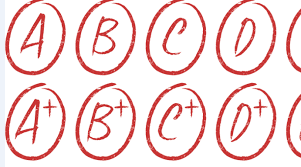

To B or not to B...Is that Really the Question?

Image
A few years ago I visited my doctor for what I hoped would be a mid-life appraisal of my health. I should say “the doctors”, since several of them assessed different parts of me over the course of a couple months. A few weeks later, I got my grade in the mail: B-. Around that time I reached out to my financial advisor to check in on the plan we’d designed the year before. I wanted to learn how well my portfolio had been performing, so she sent me an average of the year’s performance: C+. These two anecdotes are true, except for the grade part, of course. When it comes to our health and our finances, we expect a whole lot more than a single letter to communicate what’s working and what needs work. And this is the purpose of proficiency-based grading: to convey to learners, their families, and others what a single grade cannot--the learners’ current level of performance with each of the specific performance criteria used to determine the grade. But the power of the single-lette...

Hitting Targets, but Missing the Point?

Image
In his 2016 NYT editorial How Measurement Fails Doctors and Teachers , Robert M. Wachter describes how medicine and education (“our most human and sacred fields”) have taken measurement and data-based decision making too far too fast. Measuring health and learning, it turns out, is far more complex than calculating quarterly profits. “The focus on numbers has gone too far,” Wachter argues. “We’re hitting the targets, but missing the point.” What an apt description of many Vermont schools in the Age of Act 77 & Education Quality Standards (EQS), which require that all high school seniors, starting next school year, graduate from a proficiency-based school system, using their Personalized Learning Plans (PLP) to meet proficiencies set by their local school system. Next year’s deadline has many Vermont educators, especially in our high schools, scrambling to comply with these connected mandates. Proficiency-Based Graduation Requirements? Check. PLP for all? Check. New grading syste...

Why Should We (& How Can We) Engage Students in the Assessment Process?

Image
Today I’m kicking off Teachable Moments: Timely Mini-lessons & Practical Resources for the Time-Starved Teacher . Each Teachable Moments blogpost will include a short slide show / voice over to frame the topic, along with suggestions for how to use a few practical resources (included below) to apply. The Cover Page This is what the original cover page looked liked when my Bread Loaf professor, John Warnock, first asked me / my peers to complete one. Here’s a modified cover page that you can adapt to any product students are working on. Please make a copy and adapt this for you and your students’ needs. Simple Google Survey Consider regularly inviting your learners to share with you what’s working, what needs work, and what can be done about it. So simple. So effective. When Students Track Their Progress Short piece by Robert Marzano that describes the powerful impact of having students join us in tracking their learning. Such a simple way to get students mor...

The Why, What, and How of Learning Scales

Image
Why Learning Scales? In their remarkable book, Made to Stick , the Heath brothers describe a compelling and instructive experiment. Participants are divided into two groups, the tappers and the listeners. The tappers study a list of well-known American tunes (Happy Birthday to You, The Star Spangled Banner, etc.) and practice tapping out the melodies. Each listener then pairs up with a tapper, who taps out the melody of a song and then waits for the listener to name that tune. The tappers predict that the listeners will correctly guess 50% of the songs. But the listeners only correctly guess 2.5% of the songs. Why? It’s pretty simple. The tappers (teachers) forget they have the entire tune playing in their heads as they tap, and the listeners (students) do not. The listeners, according to the Heath brothers, hear a kind of “bizarre Morse Code”, while the tappers hear the whole score. Ironically, teachers’ expertise--the very trait that enables them to become teachers--can bli...

Re-Imagining the PLP: A Systems Approach to Increasing Student Ownership

Image
At last week’s   Standards-Based Learning Symposium   at St. Michael’s college, I orchestrated   a workshop   that shared this blog’s title. Not having any particular expertise with PLPs (but committed to making our schools more learner-centered and brain-friendly), I sent out an email to a swath of colleagues whom I knew had the PLP expertise I lacked. I asked them if they would help me prepare for this PLP workshop by answering these questions: 1. As you look out over the Vermont learning landscape regarding PLP, what are some of the bright spots--successes worth celebrating and emulating--you've encountered? 2. What are some of the most pressing questions educators and their learners are posing (or should be posing) about PLP? 3. What resources--texts, conferences, websites, human, other--do you recommend to educators looking to make PLP more robust and meaningful for their learners? 4. What other ideas / tips do you have that might help me become ...